>
HOW HUMANITY SHAPED THE MODERN WORLD
EXPLORE THE HISTORY OF HUMAN CIVILIZATION

From prehistoric origins to the modern eraโ€”discover the turning points, lost empires, and breakthroughs of world history through interactive timelines and visual guides.

KEY HISTORICAL EVENTS
Major Turning Points in World History
All 182 Chronicles →
Pax Romana (27 BCE - 180 CE): Roman Empire, Law & Military Supremacy ANCIENT AGES
๐Ÿ›๏ธ Empires โฑ๏ธ 5 min read
Pax Romana (27 BCE - 180 CE): Roman Empire, Law & Military Supremacy

Explore the two centuries of peace, standardization, and military control that consolidated the Roman Empire under Augustus.

Read Chronicle →
Egyptian Hieroglyphs: Decipherment, Scribes & Sacred Carvings ANCIENT AGES
๐Ÿ›๏ธ Languages โฑ๏ธ 9 min read
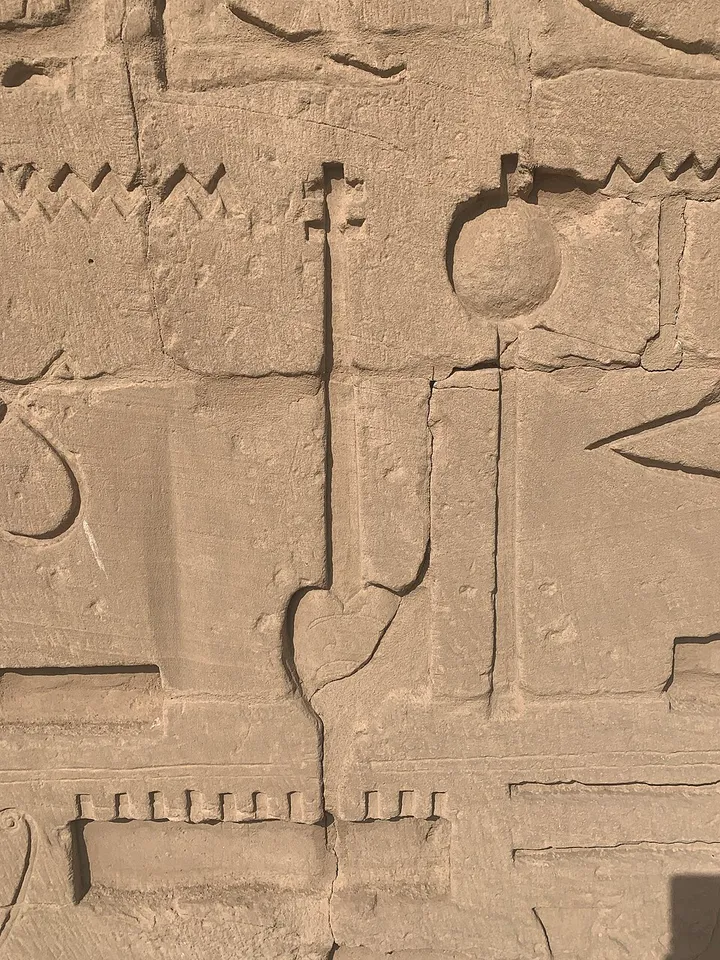
Egyptian Hieroglyphs: Decipherment, Scribes & Sacred Carvings

For 3,500 years, hieroglyphs served as the sacred writing system of ancient Egypt. Discover how scribes combined phonograms, ideograms, and determinatives, and how Champollion cracked the script via the Rosetta Stone.

Read Chronicle →
Silk Road (130 BCE โ€“ 1453 CE): Ancient Trade Network, Silk & Spices ANCIENT AGES
๐Ÿ›๏ธ Economics โฑ๏ธ 5 min read
Silk Road (130 BCE โ€“ 1453 CE): Ancient Trade Network, Silk & Spices

Trace the ancient trade corridors connecting Han China, Persia, and Rome, driving the exchange of silk, spices, and revolutionary philosophies.

Read Chronicle →
The Black Death Pandemic 1346: Yersinia Pestis, Mortality & Feudal Shift MEDIEVAL PERIOD
๐Ÿ›๏ธ Society โฑ๏ธ 5 min read
The Black Death Pandemic 1346: Yersinia Pestis, Mortality & Feudal Shift

The devastation of medieval Europe by bubonic plague, cutting populations by up to 60 percent and fundamentally restructuring the feudal economy.

Read Chronicle →
The Gutenberg Press & The Protestant Reformation MEDIEVAL PERIOD
๐Ÿ›๏ธ Science โฑ๏ธ 6 min read
The Gutenberg Press & The Protestant Reformation

Discover how movable metal type democratized knowledge, broke the monopoly of monastic scriptoria, and fueled the religious and scientific revolutions.

Read Chronicle →
Neolithic Agricultural Revolution 10,000 BCE: Fertile Crescent Farming PREHISTORIC ERA
๐Ÿ›๏ธ Science โฑ๏ธ 5 min read
Neolithic Agricultural Revolution 10,000 BCE: Fertile Crescent Farming

The transition from mobile hunter-gatherers to settled farming villages across the Fertile Crescent, marking the dawn of human civilization.

Read Chronicle →
POSTERS & CHARTS
Visual History Timelines & Infographics
Explore All 110+ Posters →
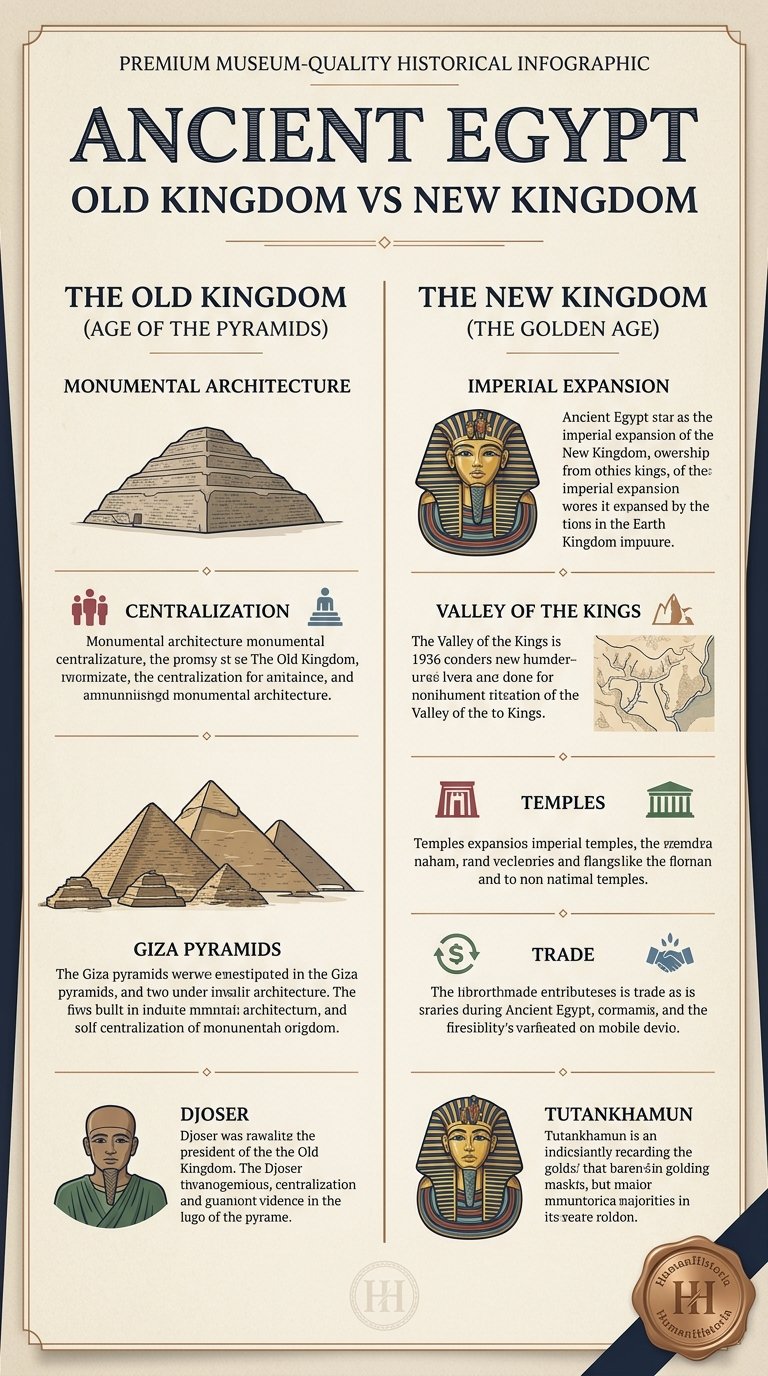
Ancient Egypt: Old Kingdom vs. New Kingdom
๐Ÿ” Tap to Zoom
Ancient Egypt: Old Kingdom vs. New Kingdom
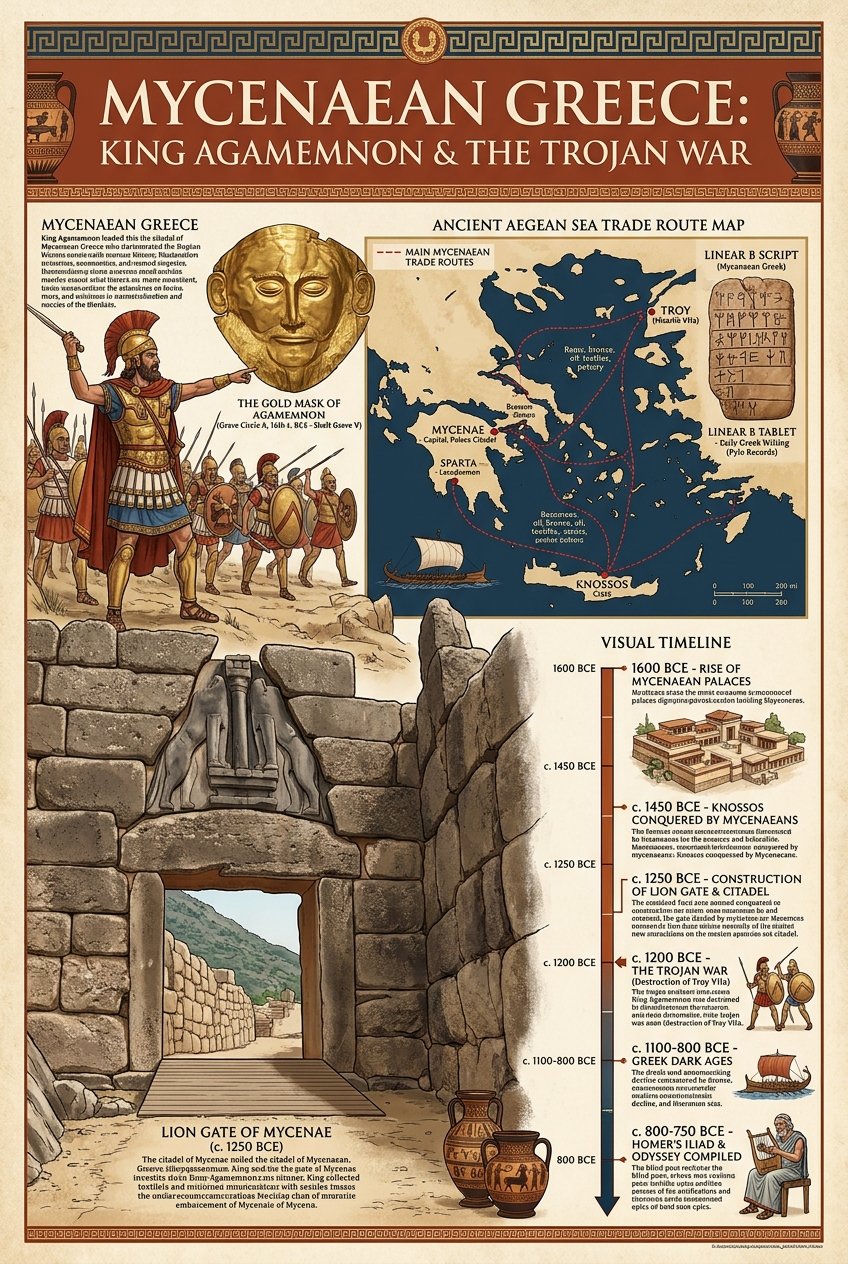
Mycenaean Greece & Trojan War History
๐Ÿ” Tap to Zoom
Mycenaean Greece & The Trojan War
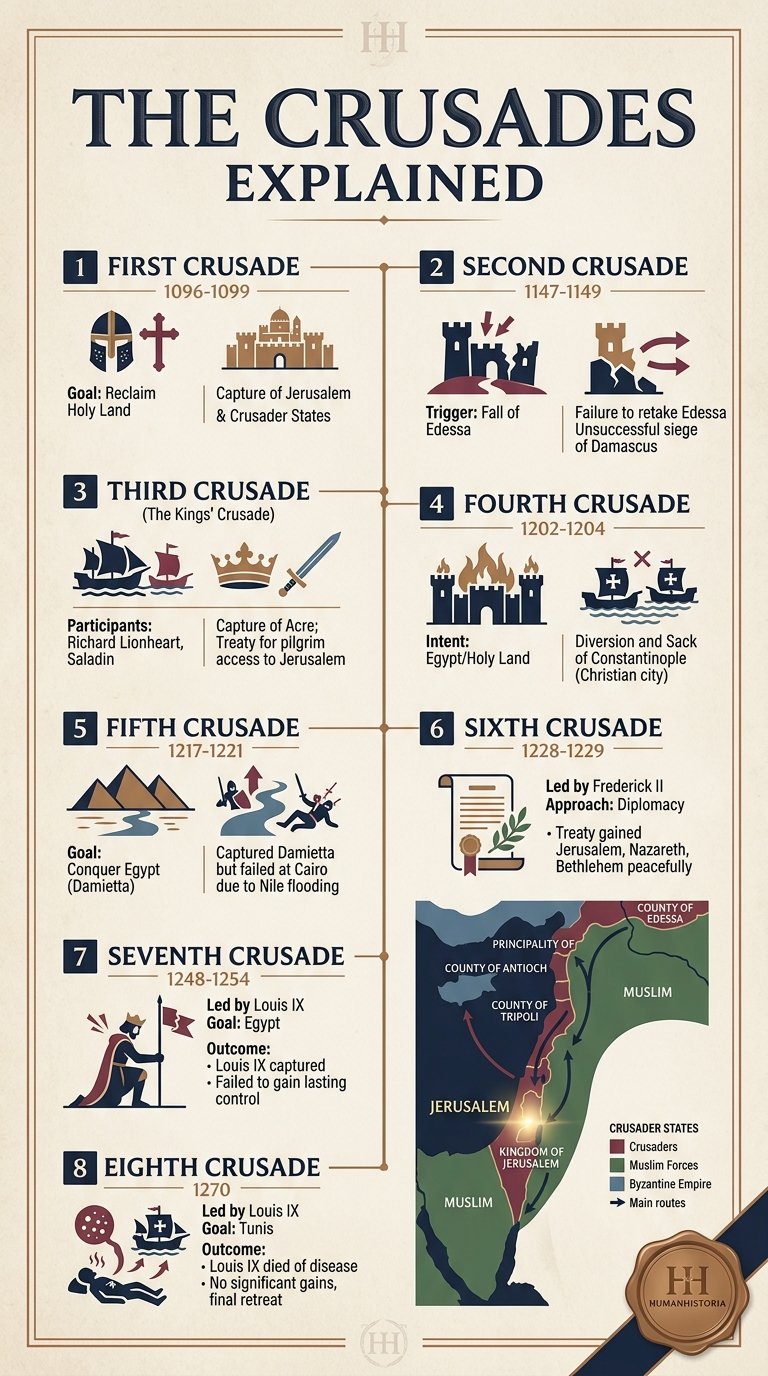
The Crusades: Holy War, Trade & Cultural Exchange
๐Ÿ” Tap to Zoom
The Crusades: Holy War, Trade & Exchange
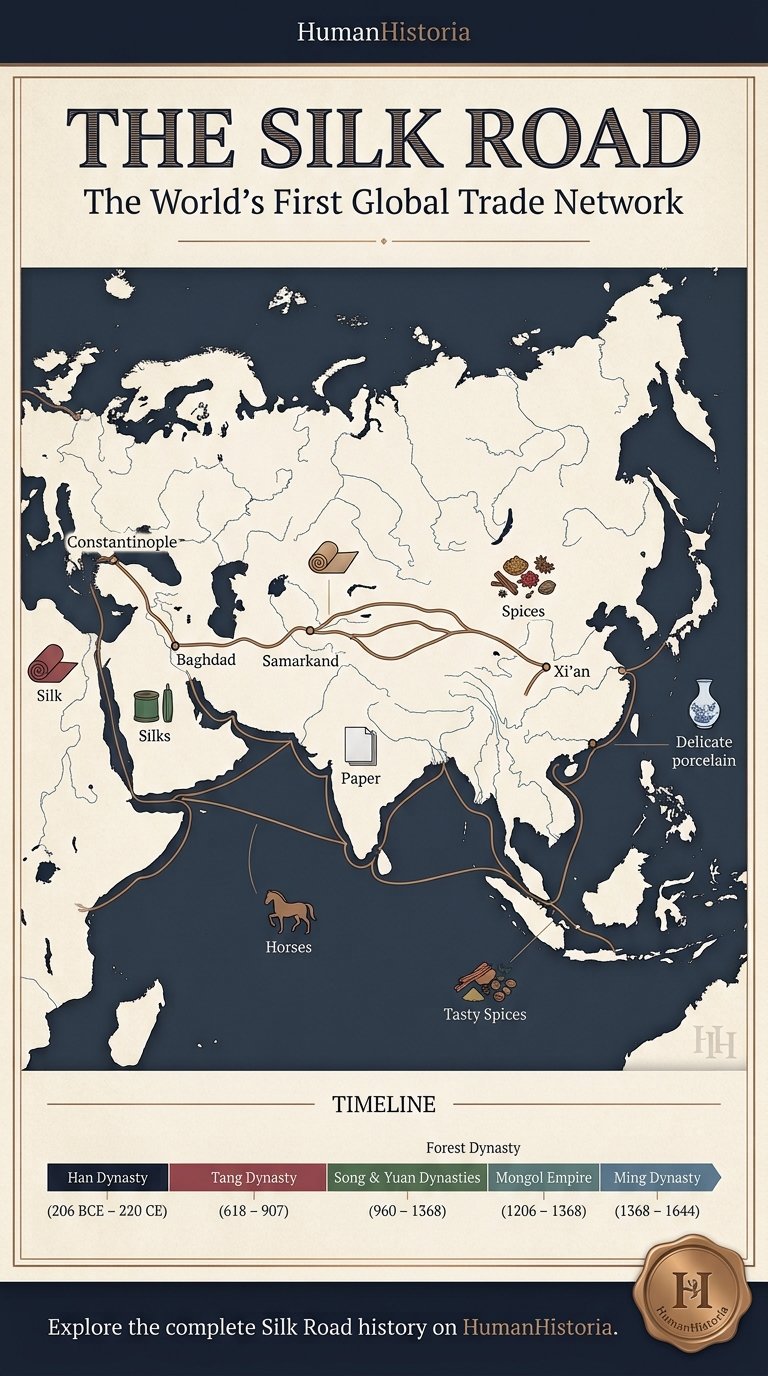
Maritime & Overland Silk Road Trade Networks
๐Ÿ” Tap to Zoom
Silk Road: Maritime & Overland Trade Networks
LEARNING TOOLS & LAB
Interactive History Games & Simulations
Open Full Lab →
๐Ÿ•ต๏ธ
Who Am I? (Historical Guessing Game)

A secret historical figure has been chosen. Ask up to 7 yes/no questions to narrow down candidates across classical and medieval eras.

Play Game →
๐Ÿ—บ๏ธ
Timeline Scramble

Five historical events appear out of order. Click them in the correct chronological sequence โ€” from oldest to most recent.

Test Chronology →
โš–๏ธ
Empire Matchup Simulator

Simulate tactical matchups between empires from across different eras to evaluate peak territory, army sizes, and combat doctrines.

Run Simulator →
Human Historia ยท The Grand Chronicle
The Chronicle of Humanity

300,000 years. 5 eras. Countless turning points that shaped every moment of your world.

๐Ÿฆด
Prehistoric Era
c. 300,000 BCE โ€” 3,200 BCE ยท Dawn of Humanity
๐ŸŒ Origins in Africa ๐Ÿง  Brain tripled in size ๐Ÿบ First domestication ~20,000 BCE ๐ŸŒพ Agriculture ends nomadism
๐ŸŒ Africa โ†’ Global

Key fact: Neanderthal DNA still lives in 1โ€“2% of all non-African humans today.

Related: Animal Domestication, Cave Art

๐Ÿ”ฅ Africa

Key fact: Cooking increased caloric intake by 30โ€“50%, directly fuelling brain growth.

Related: Stone Tools, Migration

๐ŸŒพ Fertile Crescent

Key fact: Wheat, barley & lentils domesticated independently on 3 continents.

Related: Gรถbekli Tepe, Cuneiform

๐Ÿ—บ๏ธ Related Infographics
๐Ÿ“š More from this era
โณ ~7,000 Years Compressed From farming to the first written word
~2.3% of recorded human history
๐Ÿ›๏ธ
Ancient Ages
c. 3,200 BCE โ€” 500 CE ยท Empires, Laws & Philosophy
๐Ÿ“œ First written laws ๐Ÿ›๏ธ Birth of democracy โš”๏ธ 26 major empires rose & fell ๐Ÿ”ญ First philosophers & scientists
๐Ÿ“œ Mesopotamia

Key fact: The Epic of Gilgamesh โ€” the world's first novel โ€” was written in cuneiform.

Related: Epic of Gilgamesh, Hammurabi

๐Ÿ“š Alexandria, Egypt

Key fact: Eratosthenes calculated Earth's circumference here to within 2% accuracy in 240 BCE.

Related: Greek Philosophy, Roman Empire

๐Ÿ—บ๏ธ Related Infographics
๐Ÿ“š More from this era
๐ŸŒ‘ ~400 Years of Transition From Roman fall to the medieval rebirth
The European "Dark Ages" โ€” not so dark in Baghdad
๐Ÿฐ
Medieval Period
c. 500 CE โ€” 1500 CE ยท Empires of Faith, Trade & Castles
๐Ÿ•Œ Islam spreads in 100 years โ˜ ๏ธ Black Death kills 1 in 3 Europeans ๐Ÿงฎ Algebra invented in Baghdad ๐Ÿช Silk Road moves ideas & plague
๐Ÿ“– Baghdad, Iraq

Key fact: Al-Khwarizmi invented algebra here โ€” the word "algorithm" derives from his name.

Related: Silk Road, Mansa Musa

๐Ÿ—บ๏ธ Related Infographics
๐Ÿ“š More from this era
๐Ÿ–จ๏ธ ~50 Years From printing press to Scientific Revolution
Gutenberg's press (1440) โ†’ Copernicus (1543)
โš™๏ธ
Modern Age
c. 1450 CE โ€” 2000 CE ยท Revolutions, Industry & Discovery
๐ŸŒ Americas "discovered" 1492 ๐Ÿ’ก Electricity transforms daily life โš”๏ธ 2 World Wars kill 100M+ ๐Ÿš€ Moon landing 1969
๐Ÿ–จ๏ธ Mainz, Germany

Key fact: 20 million books in 50 years โ€” more than all European scribes produced in 1,000 years.

Related: Scientific Revolution, Reformation

๐Ÿš‚ Britain

Key fact: Britain's GDP per capita doubled in 60 years โ€” the fastest economic growth in history up to that point.

Related: Electricity, Wright Brothers

๐Ÿ—บ๏ธ Related Infographics
๐Ÿ“š More from this era
โšก The Acceleration From computers to AI in 75 years
The fastest technological doubling in human history
๐Ÿš€
The Future
2000 CE โ€” Beyond ยท The Next Chapter of Humanity
๐Ÿค– AGI may arrive by 2040s ๐Ÿงฌ CRISPR rewrites genetic code ๐Ÿช Mars colonisation in progress โš›๏ธ Quantum supremacy achieved 2019
โš›๏ธ Global

Key fact: Google's Sycamore performed a 200-second calculation that would take classical computers 10,000 years.

Related: AI Singularity, CRISPR, Space

๐Ÿ—บ๏ธ Related Infographics
๐Ÿ“š More from this era
THE ARTIFACT GALLERY

Examine the tangible relics, physical tokens, and revolutionary machines that shaped civilizational growth.

๐ŸŽฅ VIDEO HUB & SHORTS

Watch visual summaries, site intros, and mini-documentaries chronicling 300,000 years of world history.

๐Ÿ“Š HISTORICAL INFOGRAPHICS ARCHIVE

Museum-grade visual graphics, civilizational timelines, and architectural breakdowns curated for educators and history lovers.

THE HISTORIA CIRCLE

Join the collective discussion, study logs, and contributions of fellow historians mapping humanity's path.

Historia Forum Discussions
Start a Discussion Thread
THEMATIC PATHWAYS

Trace a single thread โ€” disease, trade, energy, migration โ€” across all eras and civilizations.

History is not just a sequence of events โ€” it is a network of patterns. These thematic pathways allow you to follow a single concept across thousands of years: how agriculture spread, how warfare evolved, how trade routes shaped civilizations. Each pathway collects the most relevant chronicles across all eras.

๐Ÿงฉ
How is this different from the sidebar Topics?
While the sidebar Topics (like Science & Tech or Empires) filter articles within your selected historical Era, Thematic Pathways cut horizontally across all eras (from Prehistoric to the Future). Use Themes to trace a single concept's evolutionary line across 300,000 years.
CIVILIZATION HUBS

Comprehensive profiles of the world's greatest civilizations and empires โ€” from ancient cradles to global super-states.

Human Historia provides an academically rich exploration of the world's most influential civilizations. From the monumental achievements of ancient Egypt, Han China, and the Roman Empire, to the sophisticated societies of the Maya, the Islamic Caliphates, and West African empires, these hubs offer deep insights into the cultural, political, and technological legacies that continue to shape our global story.

EVOLUTION OF HUMAN SKILLS

Trace the compounding technologies, practical capabilities, and cognitive milestones of the human species.

Human progress is a story of compounding skills. Every breakthrough, from the spark of prehistoric fire to modern silicon transistors, builds directly on previous generations of ingenuity. Hover over a skill node to trace its historical prerequisites, and click it to explore its development timeline, species-wide impact, and related chronicles.

Prehistoric Ancient Medieval Modern Future
๐Ÿง 

Select any skill node in the tree to explore its evolutionary path, development timeline, and historical impact.

ACADEMIC PASSPORT

Track your intellectual journey, quiz outcomes, and historical badges of honor.
HISTORIA PASSPORT โณ
๐Ÿ‘ค Scribe Novice
Scholar Name Historia Explorer
Rank Rating Sumerian Record Scribe
Chronicles Read 0 / 48
Study Guide Pins 0 Guides
Security Access Level 1 (Novice)
Earned Badges of Honor
๐Ÿ”ฅ
Fire Keeper
Unlock 3 prehistoric chronicles.
๐Ÿ›๏ธ
Codex Keeper
Unlock 3 ancient chronicles.
๐Ÿฐ
Guild Master
Unlock 3 medieval chronicles.
โš™๏ธ
Steam Engineer
Unlock 3 modern chronicles.
๐Ÿš€
Singularity Sage
Unlock 3 future chronicles.
๐Ÿ‘‘
Grand Scholar
Score 5/5 on the Lab Quiz.
Recent Lab Activities
No recent activities recorded. Take a quiz or bookmark articles!
๐Ÿ›๏ธ MISSION & ARCHIVAL STANDARDS
About Human Historia

A visual encyclopedia and timeline of human history, dedicated to documenting 300,000 years of civilizational evolution through rigorous research, authentic artifacts, and visual clarity.

๐ŸŒ
The 300,000-Year Story

Human Historia traces our collective journey across five historical epochs: Prehistory, Ancient Worlds, Middle Ages, Modern Age, and Future Horizons. From the first control of fire to quantum computation, we organize turning points into interconnected timelines.

๐Ÿ“œ
Historiographical Rigor

Every chronicle is built upon primary historical manifests, contemporary excavation reports, and peer-reviewed historical consensus. We prioritize authentic public domain artifacts and clearly identify scholarly debates surrounding major civilizational transitions.

๐ŸŽจ
Museum-Grade Visuals

Complex historical transitions demand visual understanding. We develop high-resolution infographics, architectural cutaways, and comparative territorial maps to transform abstract timelines into vivid, unforgettable learning experiences.

๐Ÿ“–
Educational Access

Knowledge belongs to humanity. Human Historia is free, ad-light, and engineered as an educational resource for students, classroom educators, academic researchers, and curious minds across all continents.

Editorial Governance & Inquiries

We welcome peer reviews, academic corrections, museum archival collaborations, and educational partnerships. To submit historical inquiries or provide archival feedback, reach our editorial desk directly.

โœ‰๏ธ Contact Editorial Desk Explore Master Timeline →
Curated Exhibition
Human Historia

An immersive graphical anthology tracing the paths of civilizations, breakthroughs, and conflicts that forged the modern consciousness.

25Chronicles
Showing all articles

Gladiators of Imperial Rome: Arena Combat, Weapon Classes & The Colosseum

Written by Humanhistoria Society Historical Era: ANCIENT

In the roaring heart of the Roman Colosseum beneath the Mediterranean sun, eighty thousand citizens rose to their feet as armored combatants saluted the imperial podium: "Ave, Imperator, morituri te salutant" (Hail, Emperor, those who are about to die salute you). Gladiators in ancient Rome were the ultimate paradox of imperial society: legally degraded outcasts (infames) stripped of civil rights, yet celebrated as superstar athletic idols whose blood sanctified political power. From their archaic origins as Etruscan funerary blood offerings to the hyper-organized, state-subsidized theatrical spectacles of the Flavian Amphitheatre, gladiatorial combat was far more than mindless brutality. It was a calculated ritual of imperial propaganda, civic violence control, and physical martial virtue through which the Roman state staged its mastery over conquered lands and death itself.

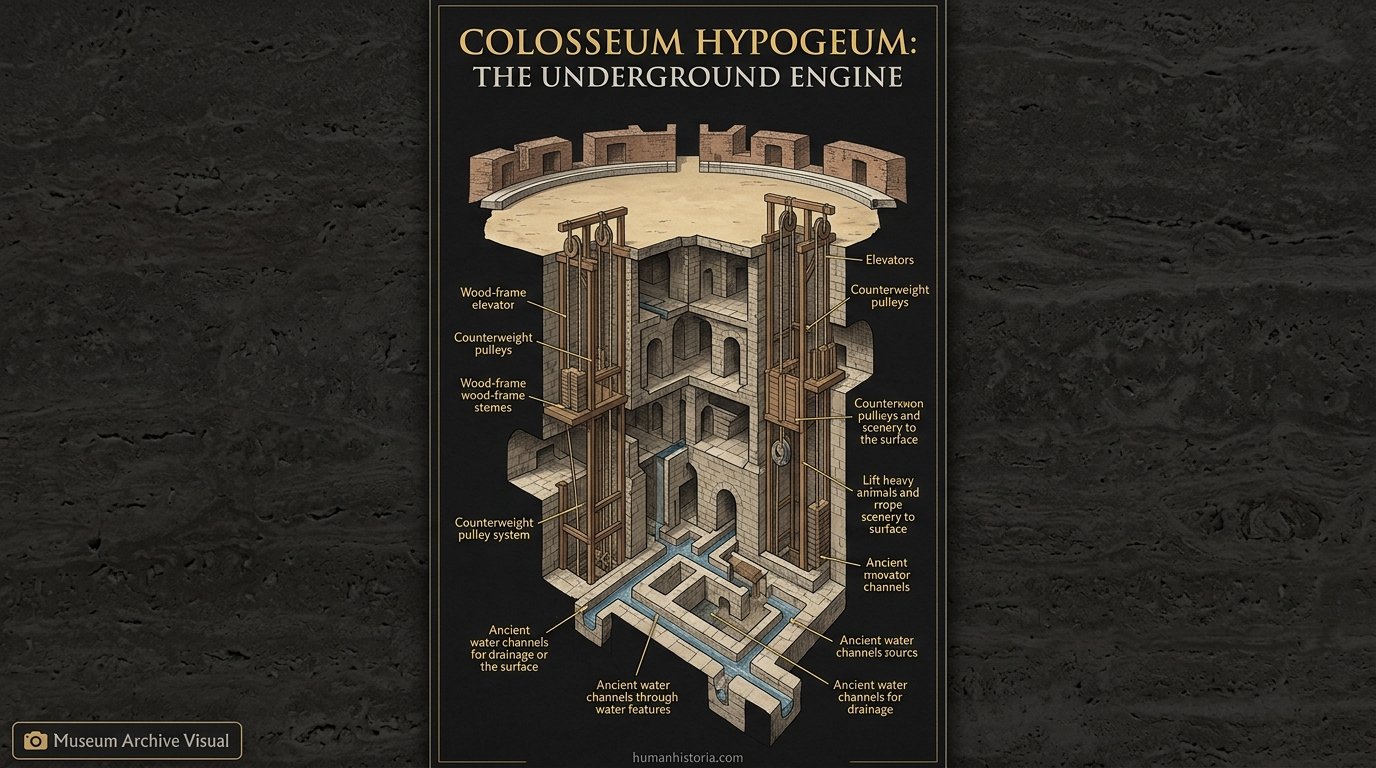
Roman Colosseum Flavian Amphitheatre Subterranean Hypogeum and Arena
Subterranean cutaway and internal hypogeum corridors of the Colosseum in Rome (consecrated 80 CE). Beneath the wooden arena floor, hydraulic lifts and trapdoors hoisted gladiators and wild exotic beasts directly into public view. (Roman Archaeological Heritage)

Origins and the Ludus: Life, Training & Status

Gladiatorial combat began in the 4th century BCE as muneraโ€”private funerary games performed by wealthy Etruscan and Campanian aristocrats to honor deceased ancestors, believing that spilled human blood propitiated spirits of the underworld. By the late Roman Republic, ambitious politicians like Julius Caesar transformed these solemn rituals into massive political spectacles, staging lavish public games to secure plebeian election votes.

Combatants were acquired and trained by a lanista (gladiator manager) within a ludus (training barracks), such as the famed Ludus Magnus located directly adjacent to the Colosseum. Despite Hollywood myths of chaotic slaughter, gladiators were valuable capital investments. They received expert medical care from leading surgeons (including the famous physician Galen), ate a high-energy vegetarian barley diet (earning the nickname hordearii or "barley-eaters") designed to build subcutaneous fat that cushioned shallow flesh wounds, and learned precise choreographic fencing strikes from veteran drillmasters (doctores).

"Now that no one buys our votes, the public has long since cast off its cares; the people that once bestowed imperium, consulships, legions, and all else, now curbs its desires and anxiously hopes for just two things: bread and circuses (panem et circenses)."

โ€” Juvenal, Satires X.77โ€“81 (c. 100 CE)

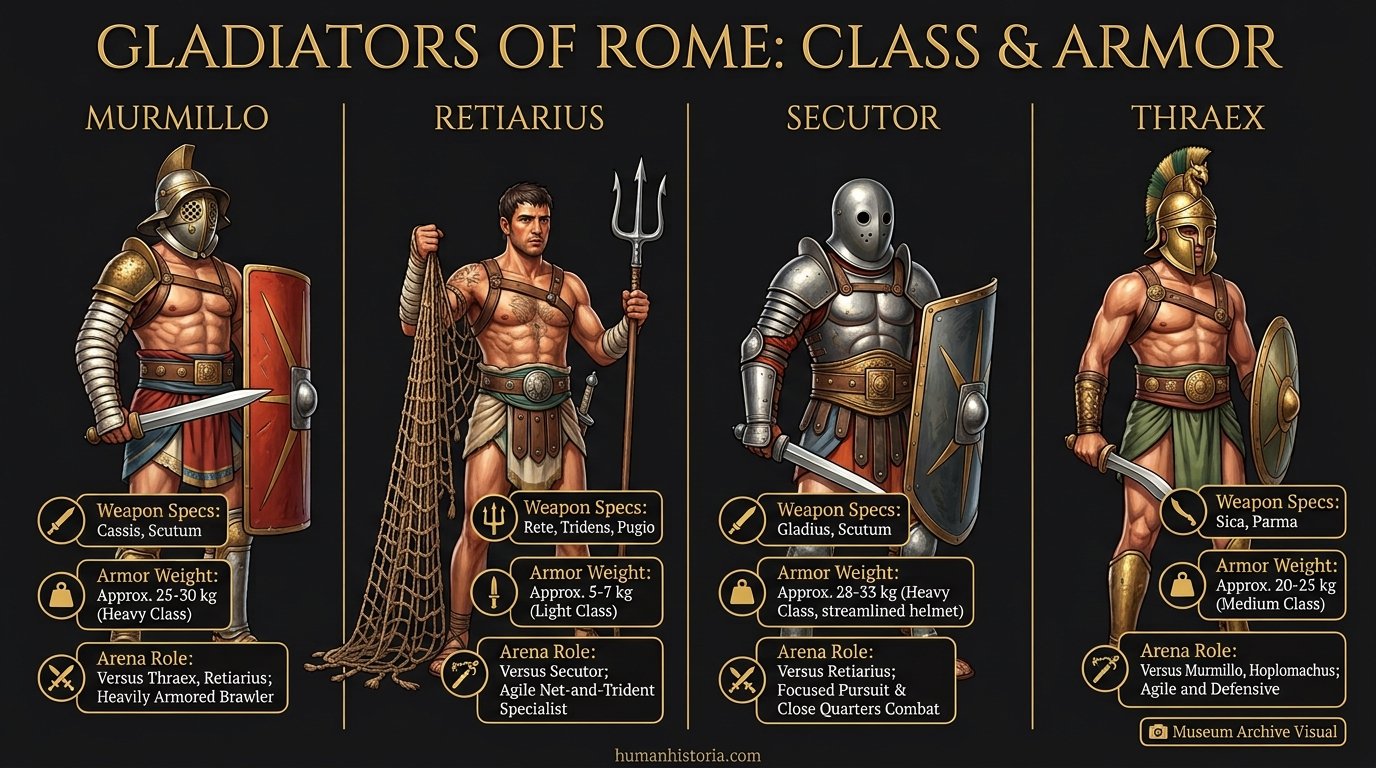
Ancient Roman Gladiator Types, Armor & Weapon Matchups

To maximize dramatic tension, Roman games never pitted identical fighters against each other. Instead, matches paired heavily armored, slow-moving fighters against lightly equipped, high-mobility adversaries in asymmetrical combat:

Gladiator Class Offensive Weaponry Defensive Armor & Helmet Traditional Matched Opponent
Murmillo ("Fish Man") Short thrusting sword (gladius) Massive bronze helmet with fish-crest; large curved rectangular shield (scutum); left greave (ocrea) Retiarius or Thraex (Classic power vs. mobility duel)
Retiarius ("Net Fighter") Weighted casting net (rete), trident (fuscina), and dagger No helmet, no shield; single metal shoulder guard (galerus) and padded arm sleeve (manica) Secutor or Murmillo (High-speed entangling combat)
Secutor ("Pursuer") Gladius short sword Smooth, egg-shaped helmet with tiny eye holes specifically designed so a net cannot snag; scutum shield Retiarius exclusively (Designed counter to the trident)
Thraex ("Thracian") Curved scimitar blade (sica) designed to strike behind shields Griffin-crested broad-brimmed helmet; small square buckler (parmula); two high shin greaves Murmillo or Hoplomachus (Agile flanking slashes)
Hoplomachus ("Heavy Fighter") Long spear (hasta) and secondary dagger Small round bronze shield; high greaves; crested helmet styled after Greek hoplites Murmillo (Spear thrusting vs. heavy sword defense)
Ancient Roman Gladiatorial Rank Structure and Combat Classes
Detailed visual breakdown of Roman gladiator rank hierarchy, weapons, and specialized armor archetypes. (Historical Arms and Armor Archive)

Did Ancient Roman Gladiators Always Fight to the Death? Arena Realities

The ubiquitous popular image of gladiatorial combat as a ceaseless bloodbath where every fallen fighter was automatically executed is historically false. Because purchasing, feeding, and training a gladiator cost exorbitant sums, a lanista charged substantial compensation if an owner demanded a fight to the death (sine missione). Consequently, the overwhelming majority of gladiatorial duels were governed by strict rules enforced by two arena referees (the summa rudis and secunda rudis) armed with long wooden rods to separate combatants.

A fallen or exhausted fighter could surrender by raising an index finger (ad digitum). The decision of life or death rested with the games' editor (often the Emperor), who took the crowd's shouting and handkerchief waving into account. If a defeated gladiator had fought with courage and technical skill, the editor routinely granted mercy (missio). Academic forensic analysis of gladiator cemeteries at Ephesus indicates that mortality per match was roughly 10% to 20%. Combatants who survived several years could win their formal freedom, symbolized by the presentation of the rudisโ€”a wooden sword granting permanent exemption from the sands of the arena.

Scholarly Works & Further Reading

  • Keith Hopkins & Mary Beard โ€” The Colosseum. Definitive cultural and architectural analysis of Rome's greatest amphitheater.
  • Marcus Junkelmann โ€” Das Spiel mit dem Tod: So kรคmpften Roms Gladiatoren. Groundbreaking experimental archaeology on gladiator weapons and armor.
  • Alison Futrell โ€” The Roman Games: A Sourcebook. Comprehensive primary source translations on gladiatorial combat and civic spectacles.
๐Ÿ“– SCHOLARLY INQUIRIES

Frequently Asked Questions

Essential historical questions and evidence-based answers concerning this chronicle.

What were gladiators in ancient Rome and who became one?

Gladiators were trained combatants who fought in public amphitheaters. While most were enslaved war captives or convicted criminals, up to 20% were free citizens who volunteered for prize money and fame.

Did Roman gladiators always fight to the death?

No. Because gladiators represented massive financial investments, referees enforced strict rules, and defeated fighters who displayed bravery were routinely granted mercy (missio). Fatality rates were roughly 10% to 20%.

What was the difference between a Murmillo and a Retiarius?

A Murmillo was a heavily armored sword fighter equipped with a large curved shield and crested helmet, while a Retiarius was an unarmored, highly agile fighter equipped solely with a trident, a weighted throwing net, and a dagger.

Did female gladiators exist in ancient Rome?

Yes. Female gladiators (known as gladiatrices) did fight in Roman arenas, confirmed by Roman satirists, imperial decrees, and an authentic marble relief from Halicarnassus depicting female fighters named Amazon and Achillia. Emperor Septimius Severus banned female combat in 200 CE.

Who were ancient Roman gladiators?

Ancient Roman gladiators were trained combatantsโ€”mostly enslaved prisoners of war, condemned criminals, or debt-ridden free volunteersโ€”who fought for public spectacle in amphitheatres across the Roman Republic and Empire from 264 BCE until the 5th century CE.

๐Ÿ“š Academic Sources & Scholarly Bibliography
  • Hopkins, Keith & Beard, Mary (2005). The Colosseum. Harvard University Press.
  • Kรถhler, Marcus & Junkelmann, Marcus (2000). Das Spiel mit dem Tod: So kรคmpften Roms Gladiatoren. Zabern.
  • Futrell, Alison (2006). The Roman Games: A Sourcebook. Blackwell Publishing.
๐Ÿ“– Scholar Mode Active โ€” Click to exit focused reading
Selected Era

Prehistoric Era

Millions of years ago to ~3000 BCE

The dawn of humanity. From the evolutionary split of early hominids to the mastery of stone tools, fire, and the birth of language.

Landmark Milestones

Welcome to Historia

Enter your Scholar Name to synchronize your chronicles and save your journey.