From prehistoric origins to the modern era—discover the turning points, lost empires, and breakthroughs of world history through interactive timelines and visual guides.
Examine the tangible relics, physical tokens, and revolutionary machines that shaped civilizational growth.
🎥 VIDEO HUB & SHORTS
Watch visual summaries, site intros, and mini-documentaries chronicling 300,000 years of world history.
📊 HISTORICAL INFOGRAPHICS ARCHIVE
Museum-grade visual graphics, civilizational timelines, and architectural breakdowns curated for educators and history lovers.
THE HISTORIA CIRCLE
Join the collective discussion, study logs, and contributions of fellow historians mapping humanity's path.
Historia Forum Discussions
Start a Discussion Thread
THEMATIC PATHWAYS
Trace a single thread — disease, trade, energy, migration — across all eras and civilizations.
History is not just a sequence of events — it is a network of patterns. These thematic pathways allow you to follow a single concept across thousands of years: how agriculture spread, how warfare evolved, how trade routes shaped civilizations. Each pathway collects the most relevant chronicles across all eras.
🧩
How is this different from the sidebar Topics?
While the sidebar Topics (like Science & Tech or Empires) filter articles within your selected historical Era, Thematic Pathways cut horizontally across all eras (from Prehistoric to the Future). Use Themes to trace a single concept's evolutionary line across 300,000 years.
CIVILIZATION HUBS
Comprehensive profiles of the world's greatest civilizations and empires — from ancient cradles to global super-states.
Human Historia provides an academically rich exploration of the world's most influential civilizations. From the monumental achievements of ancient Egypt, Han China, and the Roman Empire, to the sophisticated societies of the Maya, the Islamic Caliphates, and West African empires, these hubs offer deep insights into the cultural, political, and technological legacies that continue to shape our global story.
EVOLUTION OF HUMAN SKILLS
Trace the compounding technologies, practical capabilities, and cognitive milestones of the human species.
Human progress is a story of compounding skills. Every breakthrough, from the spark of prehistoric fire to modern silicon transistors, builds directly on previous generations of ingenuity. Hover over a skill node to trace its historical prerequisites, and click it to explore its development timeline, species-wide impact, and related chronicles.
Prehistoric Ancient Medieval Modern Future
🧠
Select any skill node in the tree to explore its evolutionary path, development timeline, and historical impact.
ACADEMIC PASSPORT
Track your intellectual journey, quiz outcomes, and historical badges of honor.
HISTORIA PASSPORT⏳
👤Scribe Novice
Scholar NameHistoria Explorer
Rank RatingSumerian Record Scribe
Chronicles Read0 / 48
Study Guide Pins0 Guides
Security AccessLevel 1 (Novice)
Earned Badges of Honor
🔥
Fire Keeper
Unlock 3 prehistoric chronicles.
🏛️
Codex Keeper
Unlock 3 ancient chronicles.
🏰
Guild Master
Unlock 3 medieval chronicles.
⚙️
Steam Engineer
Unlock 3 modern chronicles.
🚀
Singularity Sage
Unlock 3 future chronicles.
👑
Grand Scholar
Score 5/5 on the Lab Quiz.
Recent Lab Activities
No recent activities recorded. Take a quiz or bookmark articles!
🏛️ MISSION & ARCHIVAL STANDARDS
About Human Historia
A visual encyclopedia and timeline of human history, dedicated to documenting 300,000 years of civilizational evolution through rigorous research, authentic artifacts, and visual clarity.
🌍
The 300,000-Year Story
Human Historia traces our collective journey across five historical epochs: Prehistory, Ancient Worlds, Middle Ages, Modern Age, and Future Horizons. From the first control of fire to quantum computation, we organize turning points into interconnected timelines.
📜
Historiographical Rigor
Every chronicle is built upon primary historical manifests, contemporary excavation reports, and peer-reviewed historical consensus. We prioritize authentic public domain artifacts and clearly identify scholarly debates surrounding major civilizational transitions.
🎨
Museum-Grade Visuals
Complex historical transitions demand visual understanding. We develop high-resolution infographics, architectural cutaways, and comparative territorial maps to transform abstract timelines into vivid, unforgettable learning experiences.
📖
Educational Access
Knowledge belongs to humanity. Human Historia is free, ad-light, and engineered as an educational resource for students, classroom educators, academic researchers, and curious minds across all continents.
Editorial Governance & Inquiries
We welcome peer reviews, academic corrections, museum archival collaborations, and educational partnerships. To submit historical inquiries or provide archival feedback, reach our editorial desk directly.
An immersive graphical anthology tracing the paths of civilizations, breakthroughs, and conflicts that forged the modern consciousness.
25Chronicles
Showing all articles
Hannibal Barca & The Punic Wars: How Carthage Challenged Rome
Written by Humanhistoria MilitaryHistorical Era: ANCIENT
In the autumn of 218 BCE, an audacious Carthaginian army accompanied by thirty-seven war elephants emerged from the snowbound alpine passes of northern Italy, having defied freezing blizzards, treacherous rockfalls, and hostile Celtic ambushes. At their head rode thirty-year-old Hannibal Barca, a tactical genius bound by a childhood oath of eternal enmity against the expanding Roman Republic. For the next sixteen years, Hannibal campaigned undefeated across the length of the Italian peninsula, delivering masterclasses in asymmetric maneuver that annihilated entire consular hosts and pushed the Roman state to the very brink of extinction. The Second Punic War was not merely an epic duel between two titans of the ancient Mediterranean; it was the crucible that transformed Rome from a regional agrarian confederation into a merciless, militarized empire destined to dominate the Mediterranean basin.
🎯 Quick Historical Summary
What Caused the Second Punic War and What Was Hannibal's Strategy?
The Second Punic War (218–201 BCE) erupted when Carthaginian general Hannibal Barca besieged Saguntum and marched an army across the Alps into Italy. Seeking to shatter Rome's Italian alliance network through tactical encirclements at Trebia, Trasimene, and Cannae, Hannibal dominated the battlefield before Scipio Africanus defeated Carthage at Zama.
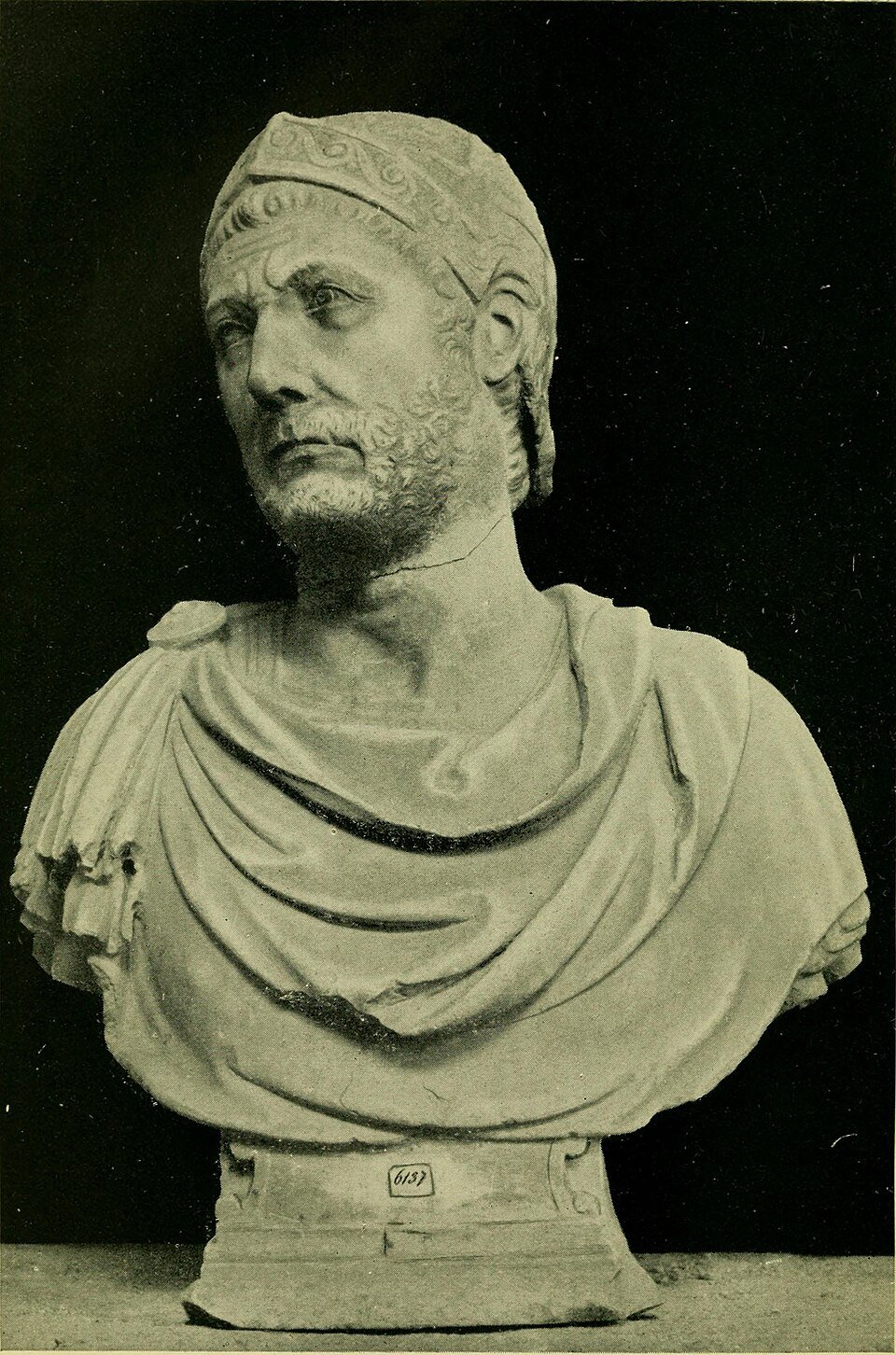
The marble bust of Capua, historically identified as a contemporary Roman portrait of Carthaginian military commander Hannibal Barca. (National Archaeological Museum of Naples, Inv. 6137)
The Origins of the Conflict: The Barcid Empire in Hispania
To understand Hannibal's audacious campaign, one must examine the bitter aftermath of the First Punic War (264–241 BCE). Carthage, a Phoenician maritime trading superpower founded in 814 BCE on the coast of modern Tunisia, had dominated Western Mediterranean sea routes for centuries. But in a grueling twenty-three-year war of attrition over Sicily, the agrarian Roman Republic built its first battle fleet from scratch, defeated Carthaginian naval forces, and imposed an indemnity of 3,200 silver talents. When Carthage was crippled by the Mercenary War (241–237 BCE), Rome seized the opportunity to annex Sardinia and Corsica, humiliating the Punic senate.
Determined to rebuild Carthaginian wealth and manpower, the Carthaginian general Hamilcar Barca ("Barca" meaning "Thunderbolt") turned westward toward the rich silver mines and warrior tribes of Hispania (modern Spain). Legend records that before departing North Africa, Hamilcar led his nine-year-old son Hannibal to the altar of the storm-god Ba'al Hammon (or Melqart) and made the boy swear a sacred oath: "Never to be a friend to Rome."
Over two decades, Hamilcar, his son-in-law Hasdrubal the Fair, and young Hannibal carved out an autonomous, wealthy Barcid empire in Spain, founding the fortified maritime naval base of Carthago Nova (Cartagena). When Hannibal assumed supreme command at age twenty-six in 221 BCE, he commanded a battle-hardened multi-ethnic army of Iberian swordsmen, Balearic slingers, and ferocious Numidian light cavalry. In 219 BCE, Hannibal laid siege to the Roman-allied coastal city of Saguntum south of the Ebro River. After an eight-month siege, the city fell; Rome declared war, anticipating a comfortable campaign fought in Spain and North Africa. Hannibal had other plans.
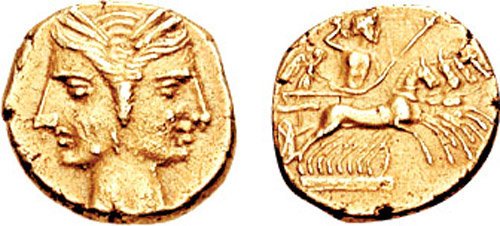
Roman gold stater minted during the crisis of the Second Punic War (c. 216–214 BCE), featuring the bifacial head of the Dioscuri and a quadriga driven by Victory. (British Museum, London)
The Alpine Crossing and the Annihilation of Roman Armies
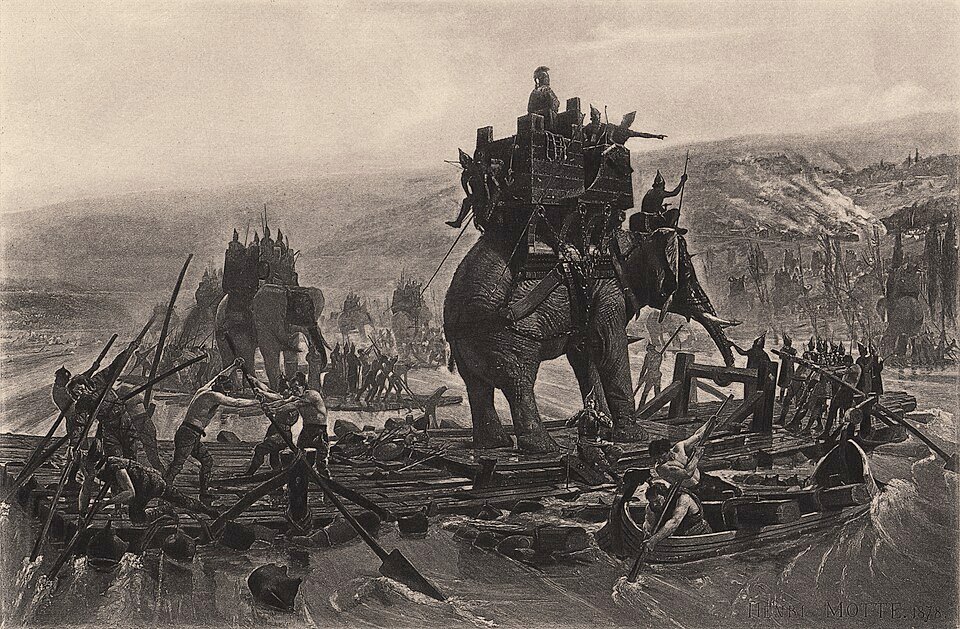
Knowing that Roman naval supremacy made a direct maritime invasion of Italy impossible, Hannibal conceived a strategic offensive of unprecedented daring: an overland invasion across the Pyrenees, southern Gaul, and the frozen heights of the Alps. In late 218 BCE, he crossed the swift Rhône River, ferrying thirty-seven war elephants on earth-covered timber rafts while outmaneuvering a Roman consular army under Publius Cornelius Scipio (the elder).
The crossing of the Alps in October 218 BCE pushed the Carthaginian army to the limits of physical endurance. Navigating treacherous snowdrifts, freezing blizzards, and rockfalls, Hannibal's troops were repeatedly ambushed by hostile Celtic Allobroges tribes hurling boulders from canyon peaks. In fifteen grueling days, Hannibal lost nearly half his infantry and thousands of cavalry horses; only a handful of war elephants survived the descent into the Po Valley. Yet he stood in the Italian heartland with 20,000 foot soldiers and 6,000 veteran cavalry, catching Rome in total strategic surprise.
The Trap at the Trebia and the Fog of Trasimene
Within weeks, northern Celtic tribes flocked to Hannibal's banner. In December 218 BCE, at the Battle of the Trebia, Hannibal demonstrated his mastery of battlefield psychology. He provoked the impetuous Roman consul Sempronius Longus into marching 40,000 freezing legionaries across the icy river at dawn without breakfast. As the exhausted, shivering Romans collided with the Carthaginian center, Hannibal's younger brother Mago sprang from a concealed marshy gully with 2,000 elite horse and infantry, smashing into the Roman rear and slaughtering over 25,000 men.
The following spring (217 BCE), Hannibal bypassed Roman defensive positions by force-marching through the flooded, malarial marshes of the Arno River for four days and nights without sleep—a journey that cost Hannibal his left eye to a severe infection. Emerging behind the army of Roman consul Gaius Flaminius, Hannibal laid the greatest ambush in military history along the narrow northern shoreline of Lake Trasimene.
On a morning shrouded in dense lakeside fog, Flaminius rushed into the narrow defile, pursuing Carthaginian rear guards. Hannibal had concealed his elite cavalry, Balearic slingers, and Iberian infantry along the forested hills above. At a single trumpet blast, the Carthaginians charged down out of the mist, trapping the entire Roman column against the lake. Within three hours, 15,000 Roman legionaries, including Flaminius himself, were killed or driven into the water to drown; an entire consular army ceased to exist.
'Hannibal's Army Crossing the Rhône' (1878) by Henri-Paul Motte, depicting Carthaginian soldiers constructing timber rafts to transport African forest war elephants across the river. (Musée des Beaux-Arts de Pau)
The Masterpiece at Cannae (216 BCE): The Perfect Encirclement
Shocked by these catastrophic defeats, the Roman Senate appointed Quintus Fabius Maximus as dictator. Fabius adopted a strategy of deliberate non-engagement—shadowing Hannibal's army, cutting off foraging parties, and refusing pitched battles. While the "Fabian strategy" preserved Roman manpower, Roman aristocratic pride chafed under the delay. In 216 BCE, the Senate assembled the largest field army Rome had ever put into the field: eight double-strength legions totaling 86,000 men under the joint command of consuls Lucius Aemilius Paullus and Gaius Terentius Varro.
On August 2, 216 BCE, on the dusty plain of Cannae along the Aufidus River in Apulia, Hannibal deployed 40,000 infantry and 10,000 cavalry against the Roman juggernaut. Knowing that the dense Roman mass would attempt to batter through his center, Hannibal arranged his battle line in an outward-pointing convex crescent:
In the center, he placed his less reliable Celtic and Spanish infantry, personally taking command alongside his brother Mago.
On the flanks, set back from the main line, he stationed his veteran, armor-clad African heavy phalanxes.
On the left wing, he massed his heavy Spanish and Celtic cavalry under Hasdrubal, while on the open right wing, his light Numidian horse kept the Roman cavalry occupied.
As the Roman legionary steamroller pressed forward, Hannibal's center executed a calculated, fighting retreat, bowing inward under pressure from a convex arch to an inverted concave pocket. Drawn forward by the apparent retreat, the Roman legions crowded inward, compressing their own ranks until men could no longer draw their swords.
At that precise moment, Hasdrubal's heavy cavalry routed the Roman horse, swept across the rear of the battlefield, and slammed into the back of the Roman infantry. Simultaneously, Hannibal's African heavy infantry wheeled inward from both flanks, closing the jaws of the trap. The encirclement was complete. Compressed into a suffocating slaughterhouse, Roman soldiers were butchered at an estimated rate of one hundred men per minute. Between 50,000 and 70,000 Romans died in a single afternoon, including Consul Paullus, eighty senators, and twenty-nine military tribunes. It remains the deadliest single day of close-quarters combat in Western military history.
Battle & Date
Combatant Strengths
Tactical Maneuver
Casualties & Strategic Result
Battle of the Trebia (Dec 218 BCE)
Rome: ~40,000 Carthage: ~30,000
Provocation across frozen river; hidden rear ambush by Mago's 2,000 cavalry
Roman defeat: 25,000+ casualties; Cisalpine Gauls revolt and join Hannibal
Battle of Lake Trasimene (June 217 BCE)
Rome: ~30,000 Carthage: ~35,000
Grand flank ambush out of dense morning fog along narrow shoreline defile
Total Roman annihilation: 15,000 killed, 10,000 captured; Consular army destroyed
Catastrophic Roman defeat: 50,000–70,000 dead; Capua and southern Italy defect
Battle of Zama (Oct 202 BCE)
Rome: ~35,000 Carthage: ~40,000
Scipio opens lane corridors for war elephants; Numidian horse smashes Punic rear
Decisive Roman victory: 20,000 Carthaginians dead; Carthage signs unconditional peace
"The Romans were surrounded on all sides and cut down by their enemies... As the outer ranks were continually killed, the survivors were forced to compress into a narrower and narrower space, until at last they were all slain where they stood... There fell eighty senators, and so great was the heap of slain that Hannibal sent to Carthage three bushels of gold rings taken from the fingers of dead Roman knights."
— Polybius, The Histories, Book III (British Library, Burney MS 34)
Rome's Resilience and Scipio's Masterstroke at Zama
In the aftermath of Cannae, Hannibal's cavalry commander Maharbal famously urged him to march immediately upon the capital: "In five days, you shall banquet in the Capitol." But Hannibal lacked siege engines, and the Roman Latin allies along the Via Appia remained stubbornly loyal. To Maharbal's famous rebuke—"You know how to win a victory, Hannibal, but not how to use it"—Hannibal replied that his strategy was not to destroy Rome's stone buildings, but to starve its confederation of allies.
Rome responded with terrifying institutional resilience. The Senate refused to ransom a single prisoner, lowered the military age to seventeen, enrolled slaves into legions with promises of freedom, and doubled taxation. For a decade, Roman armies contained Hannibal in southern Italy while taking the offensive abroad.
The turning point arrived with the rise of Publius Cornelius Scipio (later surnamed Africanus). Having survived Cannae as a young military tribune, Scipio studied Hannibal's tactics obsessively. In 209 BCE, Scipio captured Carthago Nova in Spain, crushed Hannibal's brother Hasdrubal, and in 204 BCE audaciously landed an invasion army directly in North Africa.
Faced with imminent siege, the Carthaginian senate recalled Hannibal from Italy. On October 19, 202 BCE, the two greatest commanders of the ancient world met on the plain of Zama in Tunisia. Scipio neutralized Hannibal's eighty war elephants by leaving wide open lanes (manipular corridors) between his legionary maniples; when the trumpet horns blew, the panicked beasts charged down the corridors without breaking the Roman lines. Scipio's allied Numidian cavalry under King Masinissa swept the Carthaginian horse from the field and returned to slam into Hannibal's rear—administering to Hannibal the exact double-envelopment he had perfected at Cannae.
Archival Facts: The Punic Peace Treaties
Under the Treaty of 201 BCE, Carthage was reduced to a regional vassal: it surrendered all foreign territories, surrendered its entire navy except for ten triremes, agreed to pay an astronomical indemnity of 10,000 talents over fifty years, and was forbidden from waging war anywhere in the world without Rome's explicit permission. When Carthage defended itself against Numidian border raids fifty years later, Roman hawks led by Cato the Elder invoked the treaty to launch the Third Punic War (149–146 BCE), culminating in the total destruction of Carthage and the enslavement of its 50,000 surviving citizens.
⚖️
Historian Debate: Hannibal's Grand Strategy and the Fate of Carthage
The Hegemonic Alliance Theory
Historians like Adrian Goldsworthy and Dexter Hoyos argue that Hannibal never intended to eradicate Rome as a city. His goal was an 18th-century-style limited cabinet war: to break the Italian confederation, strip Rome of its conquests, and restore Carthage as the preeminent commercial and naval hegemony in the Western Mediterranean.
The Total War Structural Failure
Scholars like Victor Davis Hanson contend that Hannibal fundamentally misunderstood the Roman cultural matrix. Rome was an agrarian citizen-militia that fought with absolute existential tenacity, refusing to accept surrender even after losing 20% of its adult male population. Carthage's commercial oligarchy was unwilling to provide the sustained naval reinforcements and money Hannibal required to seal his battlefield victories.
Contemporary archaeologists examining Roman coin hoards from 215–205 BCE trace the severe debasement of Roman silver coinage, reflecting the desperate financial strain of the war.
Long-Term Legacy & Modern Relevance
The Second Punic War transformed the Mediterranean world permanently. By surviving Hannibal's onslaught and conquering the Iberian peninsula, North Africa, and Greece, Rome eliminated its only imperial rival in the West. But victory brought fatal internal contradictions: the devastation of southern Italian farmland bankrupted peasant farmers, whose land was swallowed up by wealthy senatorial estates (latifundia) worked by hundreds of thousands of enslaved Punic and Iberian captives.
This agrarian crisis fueled the rise of landless urban mobs, populist reformers like the Gracchi brothers, and professionalized client legions loyal to ambitious warlords like Marius, Sulla, and Julius Caesar. In defeating Hannibal Barca on the battlefield, the Roman Republic unwittingly set in motion the domestic social revolutions that would bring about its own constitutional downfall.
📖 SCHOLARLY INQUIRIES
Frequently Asked Questions
Essential historical questions and evidence-based answers concerning this chronicle.
Q.How did Hannibal cross the Alps?
In 218 BCE, Hannibal marched an army of 38,000 infantry, 8,000 cavalry, and 37 war elephants through cold Alpine passes, losing nearly half his men but surprising Rome.
Q.What made the Battle of Cannae famous?
At Cannae in 216 BCE, Hannibal used a concave crescent formation that encircled and destroyed 70,000 Roman legionaries in history's classic double-envelopment tactic.
Q.Why did Carthage ultimately lose the Second Punic War?
Rome refused to surrender despite catastrophic losses, cut off Hannibal's supply lines from Spain, and dispatched Scipio Africanus to invade Carthage's homeland, defeating Hannibal at Zama in 202 BCE.
📚 Academic Sources & Scholarly Bibliography
Polybius (2010).
The Histories (Books III-XV: Punic Wars).
Oxford University Press.
Lazenby, J. F. (1998).
Hannibal's War: A Military History of the Second Punic War.
University of Oklahoma Press.
Goldsworthy, A. (2006).
The Fall of Carthage: The Punic Wars 265-146 BC.
Cassell.
📖 Scholar Mode Active — Click to exit focused reading
History Lab 🧪
Interactive historical deduction games, tactical matchup simulators, and currency calculators.
🕵️ Who Am I? (The Historical Guess Game)
A secret historical figure has been selected. Ask yes/no questions to narrow down the pool of candidates. Click any active card to make your accusation!
Secret Identity
❓ Who Am I?
Ask questions using the board below to narrow down my identity.
Ask a Question:
Question LogQuestions: 0 / 7
No questions asked yet.
Candidate Board:
🗺️ Timeline Scramble
Five historical events appear out of order. Click them in the correct chronological sequence — from oldest to most recent. How well do you know your history?
🏺 Relic or Fake?
Is this a real historical artifact or a convincing fabrication? Judge each one based on its description and era — then see the truth revealed!
Artifact 1 / 10Score: 0
Empire Matchup Simulator
Empire ATerritory Size (Peak, M km²)Empire B
00
Empire APopulation (Peak, Millions)Empire B
00
Empire AMilitary Power (Army Size)Empire B
00
Tactical Battle Analysis
Select empires and click simulate to run evaluations.
Historical Purchasing Power Converter
See what ancient coins are worth in modern terms and check their historical purchasing power.
Modern Value Equivalent
$0.00 USD
Historical Purchasing Power:
Select currency to view purchasing capability.
Historical Identity Generator
Forge an authentic historical identity from ancient civilisations, complete with linguistic meaning and biography.
Neutral
Gaius Julius
Meaning:Descendant of Jupiter
Historical Background:
A Roman citizen and clerk who worked in the forum under Roman republic rule.
Chrono-Cultural Fusion Simulator
Fuse the culture, technology, and governance of two legendary civilizations to synthesize a unique hybrid society.
Cohesion & Coexistence Rate
85%
🏛️ Hybrid Architecture
⚙️ Synthesized Asset
📜 Synthetic Governance
Historical Tactics & Trivia Quiz
Test your historical knowledge and battle tactics to claim your administrative rank.
8 Questions • Multi-Era
You will be presented with random scenarios and trivia spanning ancient Egypt, classical Rome, Islamic Golden Age, and the modern industrial era. Complete the evaluation to see your historical title!
Question 1 of 8Score: 0
What was the Code of Hammurabi written on?
Correct!
Evaluation Complete!
6 / 8
Correct
Rank Attained
Imperial Legionary
Your knowledge of classical strategy and administrative structures is respectable.
🎲 Counterfactual "What If?" Scenario Simulator
Explore alternative historical trajectories by tweaking key civilizational pivot points.
Simulated Shift
Selected Era
Prehistoric Era
Millions of years ago to ~3000 BCE
The dawn of humanity. From the evolutionary split of early hominids to the mastery of stone tools, fire, and the birth of language.
Landmark Milestones
Welcome to Historia
Enter your Scholar Name to synchronize your chronicles and save your journey.

 ⭐ Featured Chronicle

 ANCIENT AGES
 ANCIENT AGES
 ANCIENT AGES
 MEDIEVAL PERIOD
 MEDIEVAL PERIOD
 PREHISTORIC ERA