From prehistoric origins to the modern era—discover the turning points, lost empires, and breakthroughs of world history through interactive timelines and visual guides.
Examine the tangible relics, physical tokens, and revolutionary machines that shaped civilizational growth.
🎥 VIDEO HUB & SHORTS
Watch visual summaries, site intros, and mini-documentaries chronicling 300,000 years of world history.
📊 HISTORICAL INFOGRAPHICS ARCHIVE
Museum-grade visual graphics, civilizational timelines, and architectural breakdowns curated for educators and history lovers.
THE HISTORIA CIRCLE
Join the collective discussion, study logs, and contributions of fellow historians mapping humanity's path.
Historia Forum Discussions
Start a Discussion Thread
THEMATIC PATHWAYS
Trace a single thread — disease, trade, energy, migration — across all eras and civilizations.
History is not just a sequence of events — it is a network of patterns. These thematic pathways allow you to follow a single concept across thousands of years: how agriculture spread, how warfare evolved, how trade routes shaped civilizations. Each pathway collects the most relevant chronicles across all eras.
🧩
How is this different from the sidebar Topics?
While the sidebar Topics (like Science & Tech or Empires) filter articles within your selected historical Era, Thematic Pathways cut horizontally across all eras (from Prehistoric to the Future). Use Themes to trace a single concept's evolutionary line across 300,000 years.
CIVILIZATION HUBS
Comprehensive profiles of the world's greatest civilizations and empires — from ancient cradles to global super-states.
Human Historia provides an academically rich exploration of the world's most influential civilizations. From the monumental achievements of ancient Egypt, Han China, and the Roman Empire, to the sophisticated societies of the Maya, the Islamic Caliphates, and West African empires, these hubs offer deep insights into the cultural, political, and technological legacies that continue to shape our global story.
EVOLUTION OF HUMAN SKILLS
Trace the compounding technologies, practical capabilities, and cognitive milestones of the human species.
Human progress is a story of compounding skills. Every breakthrough, from the spark of prehistoric fire to modern silicon transistors, builds directly on previous generations of ingenuity. Hover over a skill node to trace its historical prerequisites, and click it to explore its development timeline, species-wide impact, and related chronicles.
Prehistoric Ancient Medieval Modern Future
🧠
Select any skill node in the tree to explore its evolutionary path, development timeline, and historical impact.
ACADEMIC PASSPORT
Track your intellectual journey, quiz outcomes, and historical badges of honor.
HISTORIA PASSPORT⏳
👤Scribe Novice
Scholar NameHistoria Explorer
Rank RatingSumerian Record Scribe
Chronicles Read0 / 48
Study Guide Pins0 Guides
Security AccessLevel 1 (Novice)
Earned Badges of Honor
🔥
Fire Keeper
Unlock 3 prehistoric chronicles.
🏛️
Codex Keeper
Unlock 3 ancient chronicles.
🏰
Guild Master
Unlock 3 medieval chronicles.
⚙️
Steam Engineer
Unlock 3 modern chronicles.
🚀
Singularity Sage
Unlock 3 future chronicles.
👑
Grand Scholar
Score 5/5 on the Lab Quiz.
Recent Lab Activities
No recent activities recorded. Take a quiz or bookmark articles!
🏛️ MISSION & ARCHIVAL STANDARDS
About Human Historia
A visual encyclopedia and timeline of human history, dedicated to documenting 300,000 years of civilizational evolution through rigorous research, authentic artifacts, and visual clarity.
🌍
The 300,000-Year Story
Human Historia traces our collective journey across five historical epochs: Prehistory, Ancient Worlds, Middle Ages, Modern Age, and Future Horizons. From the first control of fire to quantum computation, we organize turning points into interconnected timelines.
📜
Historiographical Rigor
Every chronicle is built upon primary historical manifests, contemporary excavation reports, and peer-reviewed historical consensus. We prioritize authentic public domain artifacts and clearly identify scholarly debates surrounding major civilizational transitions.
🎨
Museum-Grade Visuals
Complex historical transitions demand visual understanding. We develop high-resolution infographics, architectural cutaways, and comparative territorial maps to transform abstract timelines into vivid, unforgettable learning experiences.
📖
Educational Access
Knowledge belongs to humanity. Human Historia is free, ad-light, and engineered as an educational resource for students, classroom educators, academic researchers, and curious minds across all continents.
Editorial Governance & Inquiries
We welcome peer reviews, academic corrections, museum archival collaborations, and educational partnerships. To submit historical inquiries or provide archival feedback, reach our editorial desk directly.
An immersive graphical anthology tracing the paths of civilizations, breakthroughs, and conflicts that forged the modern consciousness.
25Chronicles
Showing all articles
AP World History: Modern Study Guide: Units 1–9, DBQ & Exam Review (1200–Present)
Written by HumanHistoria Educational EditorialHistorical Era: MODERN
AP World History: Modern Study Guide: Units 1–9, DBQ & Exam Review (1200–Present)
HumanHistoria Educational Editorial•1200 CE – Present•16 min read
Navigating eight centuries of global civilization requires more than memorizing dynasties and treaties—it demands seeing the invisible connective tissue binding human societies across continents. From the commercial crossroads of the Mongol steppes in 1200 CE to the interconnected digital supply chains of the contemporary era, the Advanced Placement (AP) World History: Modern curriculum challenges students to decipher how economic networks, imperial structures, ideological revolutions, and technological upheavals shaped our modern world. This definitive study guide breaks down all nine official College Board units, details the four-part exam format, and provides master-level strategies for conquering the Document-Based Question (DBQ).
🎯 Quick Historical Summary
What Is AP World History: Modern and What Are Its Core Exam Dates & Units?
AP World History: Modern is a college-level survey course examining global history from c. 1200 CE to the present across nine thematic units. The 3-hour and 15-minute College Board exam evaluates students through 55 Multiple Choice Questions (40%), 3 Short Answer Questions (20%), 1 Document-Based Question (25%), and 1 Long Essay Question (15%), focusing on historical causation, comparison, and continuity and change over time.
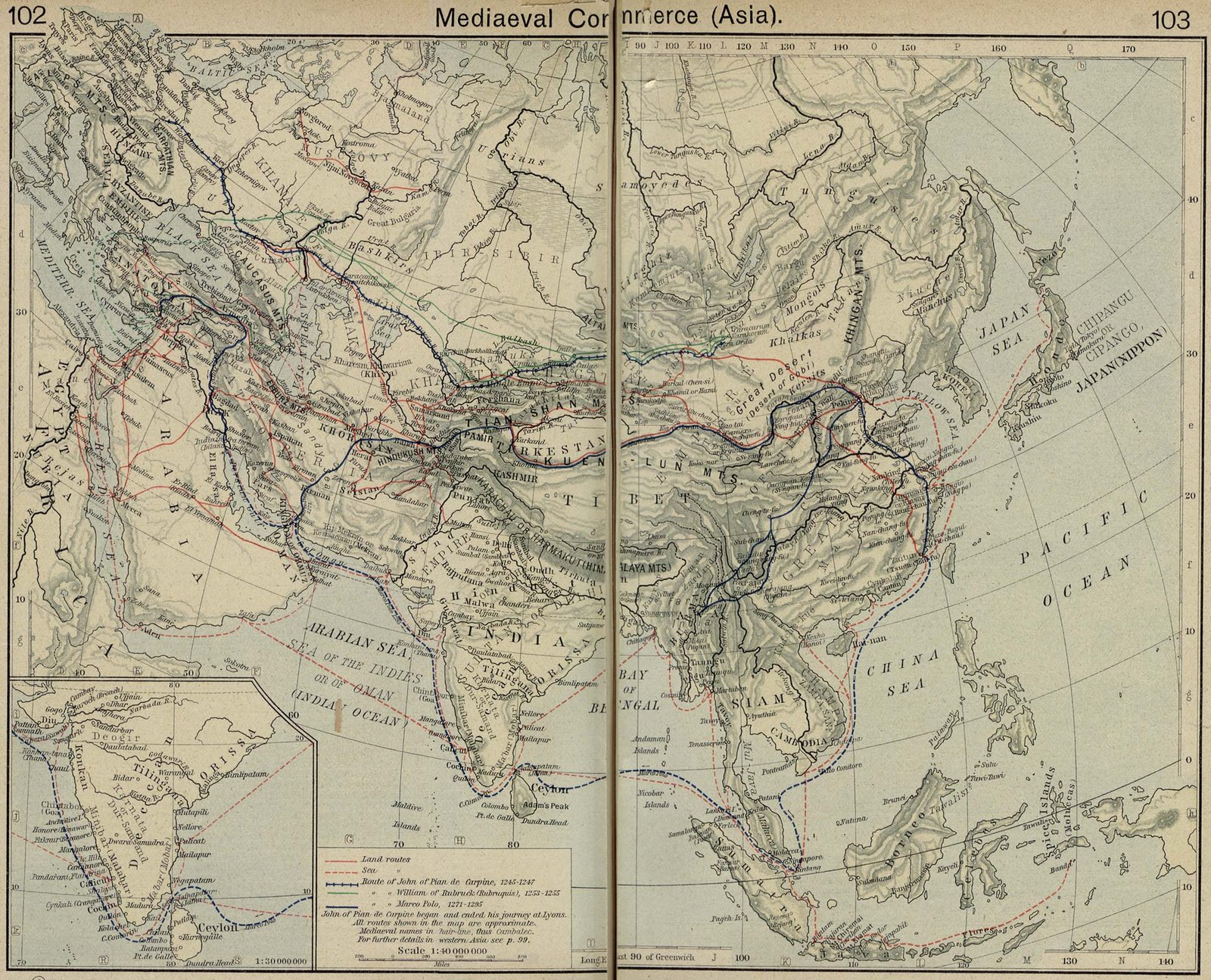
Afro-Eurasian overland trade highways and maritime circuits (c. 1200–1500 CE), illustrating the commercial convergence connecting AP World History Units 1 and 2. Map from William R. Shepherd's Historical Atlas. (Perry-Castañeda Library Map Collection)
The AP World History: Modern Exam Structure & Scoring Matrix
Success on the AP World History exam requires mastery of both historical content and specific rubric expectations. The exam spans 3 hours and 15 minutes, divided into two distinct sections that test evidence-based reasoning, contextualization, and analytical writing under timed conditions.
Exam Section
Question Count
Time Allotted
Score Weight
Core Skills Evaluated
Section I, Part A: Multiple Choice (MCQ)
55 questions
55 minutes
40%
Stimulus-based primary source excerpts, charts, and maps testing historical context and causation.
Section I, Part B: Short Answer (SAQ)
3 questions
40 minutes
20%
Three-part prompts (A, B, C) requiring concise claim-and-evidence historical explanations.
Section II, Part A: Document-Based Question (DBQ)
1 prompt (7 documents)
60 minutes (incl. 15-min reading)
25%
Formulating a thesis, contextualization, document synthesis (HIPP), outside evidence, and complexity.
Section II, Part B: Long Essay Question (LEQ)
1 prompt (choice of 3 eras)
40 minutes
15%
Developing a historically defensible argument supported by specific historical evidence without provided documents.
Diagnostic Exam Simulator
Ready to Test Your AP World History Knowledge?
Take our interactive AP-style stimulus practice exam covering Units 1–9 with instant historical explanations and score diagnostics.
The 9 AP World History Units: Complete Chronological Breakdown
The College Board organizes the curriculum into four chronological periods spanning nine thematic units. Each unit carries an assigned weight on the multiple-choice section of the annual national exam:
Unit # & Title
Chronological Era
Exam Weight
Core Civilizations & Key Turning Points
Unit 1: The Global Tapestry
c. 1200 – c. 1450
8–10%
Song Dynasty civil service & economy, Abbasid Golden Age & Dar al-Islam, Delhi Sultanate, Great Zimbabwe, feudal European kingdoms.
Unit 2: Networks of Exchange
c. 1200 – c. 1450
8–10%
The Silk Roads, Pax Mongolica and trans-Eurasian trade, Indian Ocean dhow navigation, Trans-Saharan camel caravans, Black Death pandemic.
Green Revolution agriculture, digital revolutions, globalized consumer capitalism, epidemic diseases, climate change, United Nations & NGOs.
In-Depth Period Breakdown: Key Concepts & Connections
To score well on both the multiple-choice questions and free-response essays, students must master the thematic transitions linking each chronological era:
Period 1 (c. 1200 – c. 1450): Regional Consolidation & Afro-Eurasian Commerce
Before European maritime voyages, the Afro-Eurasian landmass was linked through dense commercial arteries. In East Asia, the Song Dynasty established history's first proto-industrial commercial society, fueled by Grand Canal transport, champa rice agriculture, and paper currency. Across Southwest Asia and North Africa, the Dar al-Islam preserved and expanded scientific, astronomical, and medical knowledge. The pivotal catalyst of the era was the rise of the Mongol Empire, whose rapid conquests united Eurasia under the Pax Mongolica, standardizing passports, securing the Silk Road trade networks, and inadvertently facilitating the lethal spread of the Black Death (Yersinia pestis) across continents.
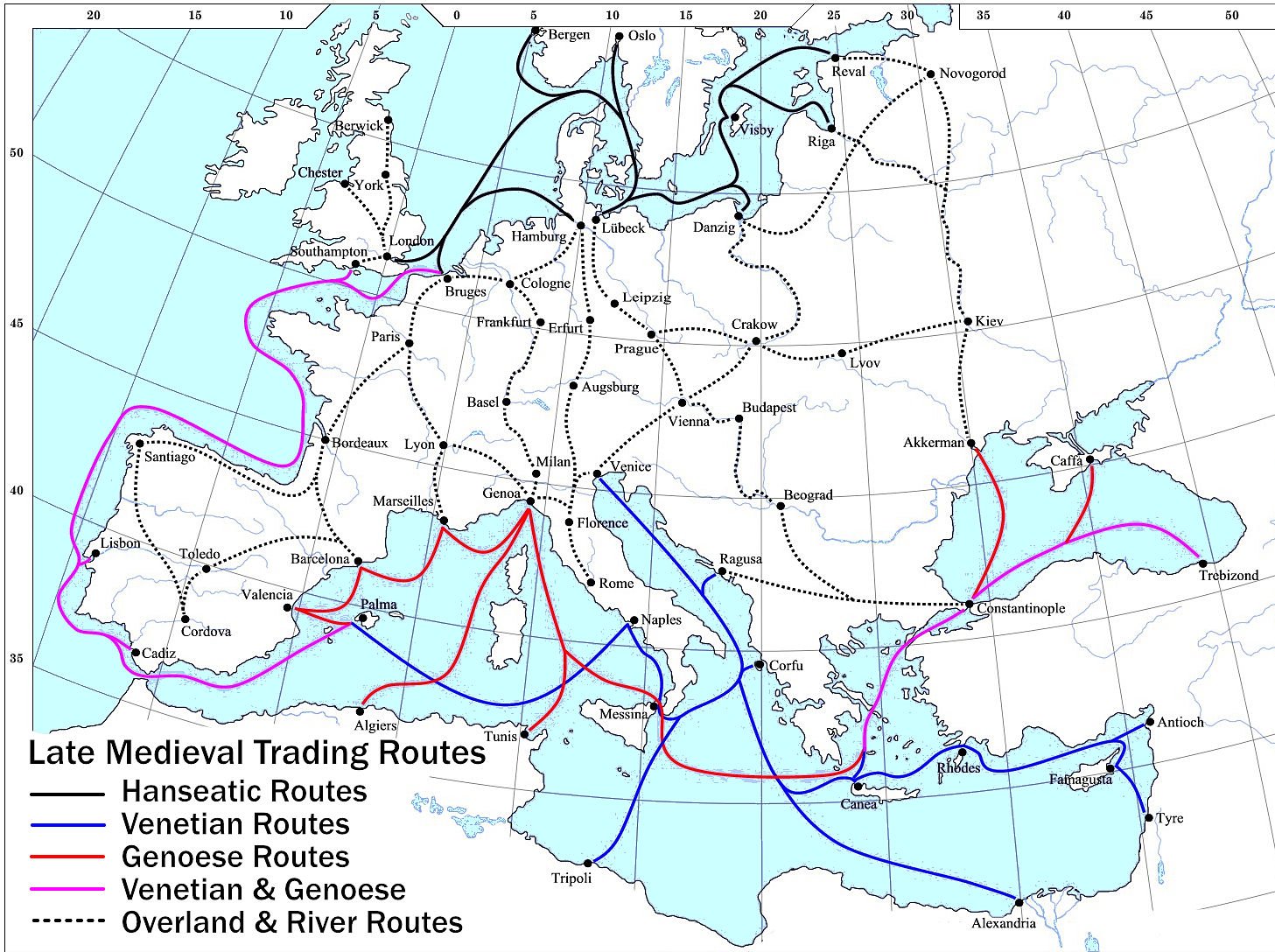
Commercial sea lanes and overland mercantile hubs of late medieval Europe (c. 1300–1450 CE), connecting Baltic Hanseatic ports to Venetian Mediterranean outposts. (Public Domain Historical Cartography Archive)
Period 2 (c. 1450 – c. 1750): Gunpowder Empires & Transoceanic Frontiers
The invention of portable gunpowder artillery revolutionized political power. Across Eurasia, land-based states—most notably the Ottoman Empire, the Safavid Dynasty of Persia, and the Mughal Empire of India—centralized administrative bureaucracies, established devshirme or mansabdari civil systems, and deployed cannons to smash feudal resistance. Concurrently, European maritime states harnessed the magnetic compass, astrolabe, and caravel to bypass Ottoman overland monopolies. The ensuing Columbian Exchange triggered the largest biological transfer in human history: American crops (potatoes, maize, cassava) sparked population booms in Europe and China, while Eurasian pathogens decimated Indigenous American populations by up to 90%.
Period 3 (c. 1750 – c. 1900): Enlightenment, Industrial Revolutions & Imperialism
The late eighteenth century unleashed twin revolutions that remade global society. Intellectually, the European Enlightenment asserted natural rights, popular sovereignty, and the social contract, igniting the American, French Revolution, and Haitian Revolutions. Mechanically, Britain's coal deposits, capital markets, and the patenting of James Watt's commercial steam engine initiated the Industrial Revolution. Industrialized nations leveraged steam-powered gunboats, telegraph cables, and Maxim machine guns to conquer overseas territories during the nineteenth-century Scramble for Africa and the exploitation of Qing Dynasty China.
Period 4 (c. 1900 – Present): Total Warfare, Decolonization & Global Networks
The twentieth century experienced unprecedented ideological confrontation and human mobilization. Imperial rivalries and military alliances triggered World War I, collapsing the Ottoman, Austro-Hungarian, German, and Russian empires. Unresolved territorial grievances and fascist totalitarianism sparked World War II, the deadliest conflict in human history, culminating in the Holocaust and the atomic bombings of Hiroshima and Nagasaki. In the post-1945 landscape, the ideological rivalry of the Cold War divided the planet between American capitalism and Soviet communism, while European exhaustion accelerated anti-colonial liberation across Asia and Africa.
AP World History DBQ Rubric & Sourcing with the HIPP Method
The Document-Based Question (DBQ) constitutes 25% of your total exam score. The official College Board AP World History DBQ rubric awards 7 distinct points:
Rubric Criteria
Points
Official College Board Scoring Standard
Thesis / Claim
1 pt
Responds to prompt with an evaluative, historically defensible claim establishing a clear line of reasoning in introduction or conclusion.
Contextualization
1 pt
Describes broader historical events, developments, or processes relevant to the prompt (before or during time period).
Document Evidence
2 pts
Uses content of at least 3 documents to address prompt (1 pt); uses at least 6 documents to actively support the thesis argument (2 pts).
Outside Evidence
1 pt
Provides at least one specific, relevant historical piece of evidence beyond the 7 provided documents.
Sourcing (HIPP)
1 pt
Explains how or why the document's historical situation, audience, purpose, or point of view is relevant to the argument for at least 3 documents.
Complex Understanding
1 pt
Demonstrates nuanced historical reasoning through corroboration, contradiction, qualification, or linking across themes.
1 Point: Thesis/Claim — Historically defensible thesis offering a clear line of reasoning (must be in the introduction or conclusion).
1 Point: Contextualization — Explaining broader historical events or developments immediately preceding or surrounding the prompt (minimum 2–3 sentences).
2 Points: Document Evidence — Accurately describing the content of at least three documents (1 pt) and using the content of at least six documents to actively support your argument (2 pts).
1 Point: Outside Evidence — Introducing a specific, relevant historical piece of evidence not mentioned in any of the seven provided documents.
1 Point: Sourcing (HIPP Analysis) — Explaining how or why the document's historical situation, audience, purpose, or point of view is relevant to your argument for at least three documents.
1 Point: Complex Understanding — Demonstrating nuanced historical insight through corroboration, qualification, or connecting across eras.
The most challenging point for students is consistently the Sourcing point. To secure this point, remember the HIPP acronym and always tie your analysis back to why it matters to the document's reliability or argument:
"The merchants of China and India trade here with silks and spices beyond reckoning. The ruler ensures absolute safety on the highways, so that an unarmed traveler with a chest of gold may pass unharmed through his realms."
— Ibn Battuta, The Rihla (Travels across Afro-Eurasia, c. 1354 CE, Bibliothèque nationale de France)
Sample HIPP Breakdown for the Excerpt Above:
H — Historical Situation: Written during the height of the Pax Mongolica and Islamic commercial hegemony across the Fourteenth-Century Silk Roads and Indian Ocean trade networks.
I — Intended Audience: Primarily Muslim scholars, jurists, and the Marinid royal court in Morocco who appreciated descriptions of international Islamic jurisprudence and royal administration.
P — Purpose: To document the vast reach of the Islamic world (Dar al-Islam), glorify benevolent rulers who protected Muslim merchants, and compile an entertaining travel memoir.
P — Point of View: As an elite Islamic qadi (legal judge) from Tangier, Ibn Battuta views non-Muslim societies through a strict orthodox Islamic legal lens, consistently praising rulers who enforce order, Islamic law, and merchant hospitality.
Essential AP Historical Thinking Skills
The College Board designs all free-response prompts around three core historical thinking reasoning processes. Identifying which process your prompt demands is essential for scoring full points:
Causation (Cause and Effect): Distinguish between immediate triggers (proximate catalysts) and underlying long-term structural causes. For example, when evaluating the causes of World War I, contrast the immediate catalyst (the assassination of Archduke Franz Ferdinand) with underlying structural pressures (militarism, imperial rivalries, and alliance systems).
Comparison (Similarities and Differences): Compare historical developments across different geographic regions within the same era. For example, analyze similarities and differences between the imperial consolidation of the land-based Ottoman Empire versus the maritime expansion of the Spanish Empire in the sixteenth century.
Continuity and Change over Time (CCOT): Trace what fundamental patterns persisted and what revolutionary transformations occurred across a multi-century span. For example, evaluate the extent to which trade networks in the Indian Ocean basin changed following the arrival of Portuguese and Dutch armed merchant ships after 1500 CE.
College Board. AP World History: Modern Course and Exam Description (CED). College Board AP Program, New York, 2024.
Bentley, Jerry H., and Herbert F. Ziegler. Traditions & Encounters: A Global Perspective on the Past. McGraw-Hill Education, 2020.
Strayer, Robert W., and Eric W. Nelson. Ways of the World: A Global History with Sources for AP. Bedford/St. Martin's, 2021.
Shepherd, William R. Historical Atlas. Henry Holt and Company, New York, 1923; Perry-Castañeda Library Map Collection, University of Texas at Austin.
Dunn, Ross E. The Adventures of Ibn Battuta: A Muslim Traveler of the Fourteenth Century. University of California Press, 2012.
📖 SCHOLARLY INQUIRIES
Frequently Asked Questions
Essential historical questions and evidence-based answers concerning this chronicle.
Q.How can I score a 5 on the AP World History: Modern exam?
Scoring a 5 requires combining solid chronological content knowledge with rubric mastery. Practice writing timed DBQ and LEQ essays using the official College Board rubrics, master the HIPP sourcing technique on primary documents, memorize 2–3 specific pieces of historical outside evidence per unit, and focus on thematic causation rather than memorizing isolated dates.
Q.What are the 9 units of AP World History: Modern and their exam weights?
The nine units are: Unit 1 Global Tapestry (8–10%), Unit 2 Networks of Exchange (8–10%), Unit 3 Land-Based Empires (12–15%), Unit 4 Transoceanic Interconnections (12–15%), Unit 5 Revolutions (12–15%), Unit 6 Consequences of Industrialization (12–15%), Unit 7 Global Conflict (8–10%), Unit 8 Cold War and Decolonization (8–10%), and Unit 9 Globalization (8–10%). Units 3 through 6 carry the heaviest multiple-choice weight (nearly 60% combined).
Q.What is the HIPP method for the AP World History DBQ?
HIPP is an analytical framework used to earn the document sourcing point on the DBQ. For at least three documents, you must explain how the document's Historical situation, Intended audience, Purpose, or author's Point of view is relevant to your thesis argument. Simply stating who wrote the document is insufficient; you must explain how their perspective influences the document's reliability or claims.
Q.What time period is covered on the AP World History: Modern exam?
The AP World History: Modern exam covers history from c. 1200 CE to the present day. Earlier historical developments prior to 1200 CE (such as Classical Greece, Rome, the Han Dynasty, and early religious origins) are tested only as historical context or background knowledge, not as standalone essay prompts.
Q.What is the official AP World History DBQ rubric?
The official College Board DBQ rubric awards 7 total points: 1 point for Thesis/Claim, 1 point for Contextualization, 2 points for Document Evidence (supporting an argument with at least 6 documents), 1 point for Outside Evidence, 1 point for Sourcing (using HIPP on at least 3 documents), and 1 point for Complex Understanding.
📚 Academic Sources & Scholarly Bibliography
College Board (2024).
AP World History: Modern Course and Exam Description (CED).
College Board AP Program, New York.
Bentley, Jerry H., and Herbert F. Ziegler (2020).
Traditions & Encounters: A Global Perspective on the Past.
McGraw-Hill Education.
Strayer, Robert W., and Eric W. Nelson (2021).
Ways of the World: A Global History with Sources for AP.
Bedford/St. Martin's.
Shepherd, William R. (1923).
Historical Atlas.
Henry Holt and Company, New York; Perry-Castañeda Library Map Collection.
Dunn, Ross E. (2012).
The Adventures of Ibn Battuta: A Muslim Traveler of the Fourteenth Century.
University of California Press.
📖 Scholar Mode Active — Click to exit focused reading
History Lab 🧪
Interactive historical deduction games, tactical matchup simulators, and currency calculators.
🕵️ Who Am I? (The Historical Guess Game)
A secret historical figure has been selected. Ask yes/no questions to narrow down the pool of candidates. Click any active card to make your accusation!
Secret Identity
❓ Who Am I?
Ask questions using the board below to narrow down my identity.
Ask a Question:
Question LogQuestions: 0 / 7
No questions asked yet.
Candidate Board:
🗺️ Timeline Scramble
Five historical events appear out of order. Click them in the correct chronological sequence — from oldest to most recent. How well do you know your history?
🏺 Relic or Fake?
Is this a real historical artifact or a convincing fabrication? Judge each one based on its description and era — then see the truth revealed!
Artifact 1 / 10Score: 0
Empire Matchup Simulator
Empire ATerritory Size (Peak, M km²)Empire B
00
Empire APopulation (Peak, Millions)Empire B
00
Empire AMilitary Power (Army Size)Empire B
00
Tactical Battle Analysis
Select empires and click simulate to run evaluations.
Historical Purchasing Power Converter
See what ancient coins are worth in modern terms and check their historical purchasing power.
Modern Value Equivalent
$0.00 USD
Historical Purchasing Power:
Select currency to view purchasing capability.
Historical Identity Generator
Forge an authentic historical identity from ancient civilisations, complete with linguistic meaning and biography.
Neutral
Gaius Julius
Meaning:Descendant of Jupiter
Historical Background:
A Roman citizen and clerk who worked in the forum under Roman republic rule.
Chrono-Cultural Fusion Simulator
Fuse the culture, technology, and governance of two legendary civilizations to synthesize a unique hybrid society.
Cohesion & Coexistence Rate
85%
🏛️ Hybrid Architecture
⚙️ Synthesized Asset
📜 Synthetic Governance
Historical Tactics & Trivia Quiz
Test your historical knowledge and battle tactics to claim your administrative rank.
8 Questions • Multi-Era
You will be presented with random scenarios and trivia spanning ancient Egypt, classical Rome, Islamic Golden Age, and the modern industrial era. Complete the evaluation to see your historical title!
Question 1 of 8Score: 0
What was the Code of Hammurabi written on?
Correct!
Evaluation Complete!
6 / 8
Correct
Rank Attained
Imperial Legionary
Your knowledge of classical strategy and administrative structures is respectable.
🎲 Counterfactual "What If?" Scenario Simulator
Explore alternative historical trajectories by tweaking key civilizational pivot points.
Simulated Shift
Selected Era
Prehistoric Era
Millions of years ago to ~3000 BCE
The dawn of humanity. From the evolutionary split of early hominids to the mastery of stone tools, fire, and the birth of language.
Landmark Milestones
Welcome to Historia
Enter your Scholar Name to synchronize your chronicles and save your journey.
 ⭐ Featured Chronicle
 ANCIENT AGES
 ANCIENT AGES
 ANCIENT AGES
 MEDIEVAL PERIOD
 MEDIEVAL PERIOD
 PREHISTORIC ERA